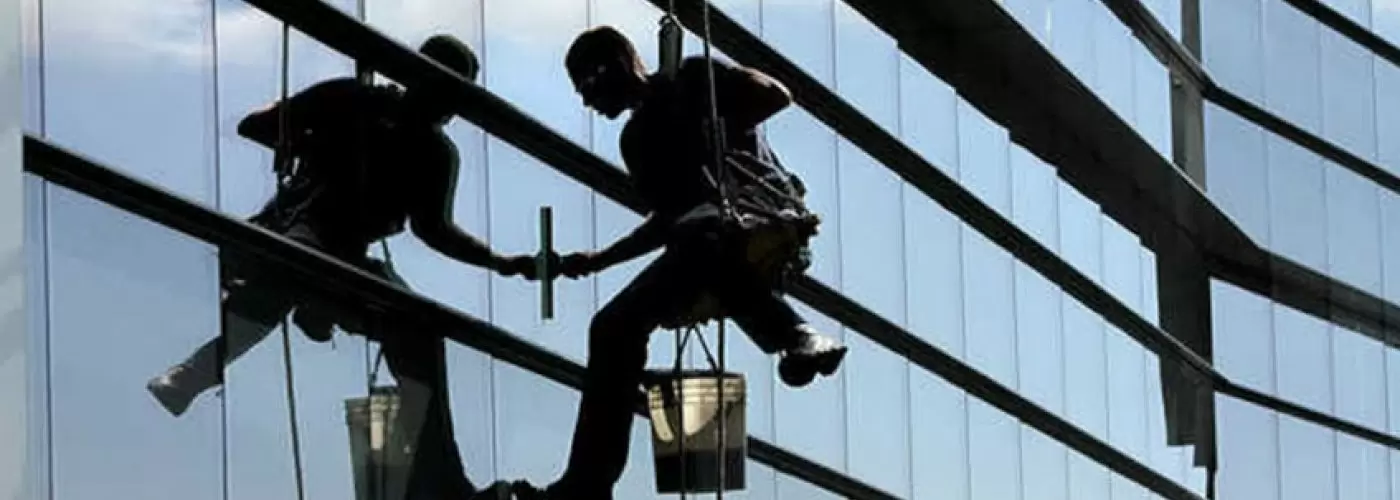
Above the fortieth floor
The world above the fortieth floor is an almost silent one, isolated and exhilarating.
Shortly after dawn one December morning, Bob Menzer rode the freight elevator to the forty-fifth floor of the Hearst Tower, on Eighth Avenue in Manhattan, and opened the door to the roof. The weather was clear and cold; five hundred feet above the street, the rooftop was silent except for the hum of giant air-conditioning fans. Menzer, a soft-spoken, bearded fifty-four-year-old with a nervous laugh, narrow blue eyes, and a thick shock of brown hair, was the rigging foreman of the tower’s window-cleaning crew. He had risen at 3 A.M. to travel to Hearst from his home in Queens, and clocked in at five. He wore dark-blue overalls, a yellow fall-protection harness, and heavy gloves. Carrying a checklist on a clipboard, he was joined by Ron Brown, fifty-eight, and Janusz Kasparek, fifty-five. Together they prepared to go “over the side” in the basket of the most complex window-washing rig in New York. Menzer chuckled as he showed me the machine for the first time. “It’s a little monster,” he said.
When the architect Norman Foster initially presented sketches for the Hearst Tower, the first skyscraper approved for construction in Manhattan after September 11th, one of the questions the building’s prospective owners asked was: How are we going to clean those windows? Foster’s proposal featured curtain walls of glass and stainless steel hung in a diagonal grid that met at each corner of the structure in a dramatic chamfer, a zigzag bevelled edge formed of four concave diamond shapes, each sixteen feet deep and eight stories high, known as “bird’s mouths” by the architects. These would have the effect of making the finished building look like a colossal, finely cut jewel. But there was no means of making them accessible to a window cleaner.
In early 2002, Foster + Partners’ associate architects approached Tractel-Swingstage, one of the world’s largest manufacturers of scaffolds and window-washing platforms, based in Toronto, to provide a solution. The task fell to the company’s vice-president of engineering at the time, Lakhram Brijmohan, who has spent a thirty-year career developing cleaning rigs but had never seen anything like the “bird’s mouths.” Designing and building the machine took a team of Tractel engineers three years. The result, a rectangular steel box the size of a Smart car, supporting a forty-foot mast and a hydraulic boom arm attached by six strands of wire rope to a telescopic cleaning basket, houses a computer that monitors sixty-seven electromechanical safety sensors and switches, and runs around the roof of the Hearst Tower on four hundred and twenty feet of elevated steel track. When it was finally installed, in April, 2005, at a cost of some three million dollars, it was described by Scott Borland, the project’s construction manager, as being “like a ride at Disneyland.”
Bob Menzer told me that safety checks and delicate maneuvering of the machine mean that it can take almost an hour each morning before he is finally in position to begin washing windows, for which he uses water and dish soap—“a good squirt” of either lemon-scented Dawn or Joy. A sophisticated device for containing this concoction has not yet been devised. “It’s just a bucket,” Menzer said. “Nothing too special.”
The commercial window-washing industry in New York emerged with the rise of the skyscraper, at the end of the nineteenth century, after one Polish immigrant, seeing an opportunity, organized a team of expert window cleaners—mostly Poles—whom he let out on contract. This set a pattern for specialization in the trade by one ethnicity after another: the Poles were followed by the Ukrainians, then the Italians and the Irish. “We’re like the aboveground sandhogs,” Bill Fitzgerald, the former director of operations at Palladium Window Solutions, which held the contract for the Hearst Tower for several years, told me one afternoon in the cluttered and windowless basement room that served as his midtown office. The latest influx of immigrant window washers has come from South America: Fitzgerald’s crews included men from Peru, Guatemala, and Ecuador.
In the early years, skyscraper windows were routinely cleaned by a washer simply standing outside on the ledge and gripping the frame, or “fingering.” In the first decade of the last century, they began using leather safety belts, buckled at the waist and fitted with straps that attached to a pair of anchor bolts installed in the brickwork surrounding each window. By 1931, when the Empire State Building was completed, there were between two and three thousand window cleaners in New York; eventually, a crew of eight men worked in two teams on the tallest building in the world, balanced on ledges no more than two inches wide, to clean each of the sixty-five hundred windows.
It was a trade for which little or no education was necessary, although admission to the union has rarely been easy without a personal connection. Bill Fitzgerald’s older brother Joey, at forty-four a gravel-voiced smoker with a windburned complexion and a sardonic sense of humor, has worked at the Empire State Building for nineteen years, most of them in the company of Andy Hock, a childhood friend from Woodhaven, Queens. Described by one colleague as “the No. 1 man on the No. 1 building in the city,” Hock is a union shop steward at Local 32BJ, the most senior of the three veterans who form the permanent cleaning crew at the Empire State Building, and the scion of a dynasty of window washers. His father, Louis, a second-generation German immigrant born in Brooklyn—and a bodybuilder who was known as Papa Smurf by younger cleaners—was followed into the business by five brothers, in the late fifties. “They got their sons in, and then their sons-in-law in, and it started coming down the tree,” Hock, a stocky forty-one-year-old with a shaved head and a goatee, told me recently. He joined the union on his eighteenth birthday, and got Fitzgerald in six months later. He now has thirty or forty relatives who are window cleaners. “I got three daughters. I don’t have any sons,” he told me. “But I’m sure one of them’s gonna come up and be, ‘Dad, you gotta get my husband a job window washing.’ ” In New York, the trade remains an almost exclusively male preserve. Hock told me that one of the few female window cleaners in the city, his cousin’s granddaughter, stopped work when she became pregnant. “It’s a man’s job,” he said. Hock has worked at the Empire State Building since 1996. His right calf is covered with a tattoo of the skyscraper silhouetted against a mackerel sky; scaling the façade is a giant figure, twenty-five stories tall, wearing overalls and carrying a bucket.
 Facebook
 LinkedIn
 Pinterest
 Twitter