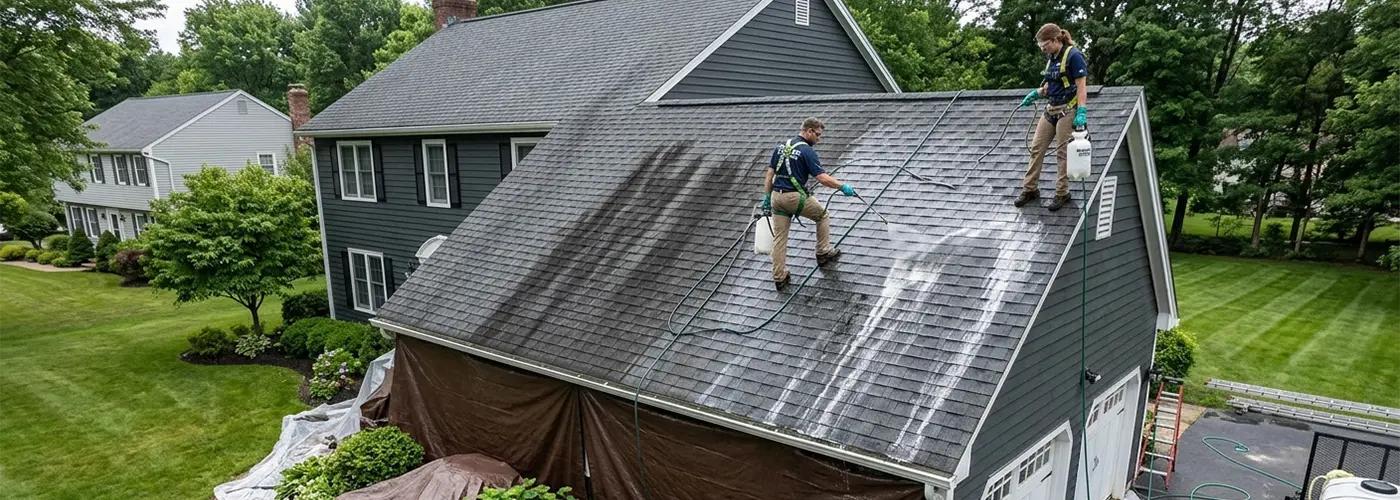
Homeowners often worry that roof cleaning products will kill plants, weaken shingles, or contaminate soil. These concerns are valid. In this article, we explain the difference between eco-friendly detergents and harsh chemicals in roof cleaning, what industry standards actually recommend, and how to choose a method that is both effective and responsible.
What causes black streaks on roofs?
The dark streaks commonly seen on asphalt shingle roofs are caused by Gloeocapsa magma, a type of cyanobacterium. According to the Asphalt Roofing Manufacturers Association, this organism feeds on limestone filler used in shingles and can spread across roofing surfaces in humid environments [1].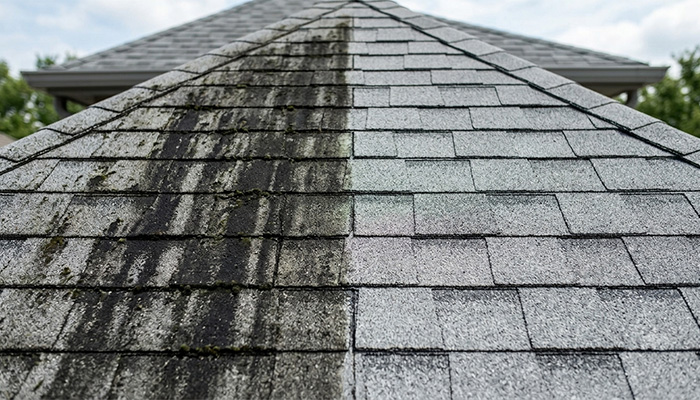
If left untreated, algae can cause several problems for your roof. They trap moisture against the shingles, which may increase wear over time. They can also reduce the roof’s reflective performance, making it less efficient in handling sunlight. In addition, algal growth shortens the roof's visual lifespan and creates uneven, dark discoloration that affects the overall appearance of your home.
Because Gloeocapsa magma is a living organism, removing it requires a solution that neutralizes biological growth at its root.
What does ARMA recommend for asphalt shingle roof cleaning?
When cleaning asphalt shingles, following the manufacturer's guidelines is critical to avoid voiding the warranty.The Asphalt Roofing Manufacturers Association states that algae stains can be removed with a solution containing sodium hypochlorite, typically applied via a low-pressure soft-wash system. High-pressure washing is not recommended, as it may damage shingles and void warranties [1].
This leads to an important clarification:
- Soft washing is the industry standard
Soft washing uses low pressure combined with a cleaning solution to kill algae at the source. It avoids the granule loss and structural damage associated with pressure washing. - Sodium hypochlorite is effective against algae
When diluted and applied properly, it neutralizes biological growth, such as Gloeocapsa magma. This ensures longer-lasting results compared to surface-only cleaners. - Pressure washing is not recommended
High pressure can strip protective granules from shingles and compromise their lifespan. - Proper rinsing is essential
After dwell time, the roof is thoroughly rinsed to prevent residue buildup and to ensure the safety of surrounding materials.
In other words, “eco-friendly” does not mean “no chemistry.” It means responsible chemistry applied correctly.
Eco-friendly detergents: What do they really mean?
The term eco-friendly is often used broadly in marketing, and its meaning can vary. In roof cleaning, it usually refers to practices rather than the complete absence of chemicals. This may include the use of biodegradable surfactants, carefully controlled dilution ratios, plant-safe application methods, and responsible runoff management to reduce environmental impact.Biodegradable surfactants help the cleaning solution adhere to algae while minimizing environmental persistence. However, mild or “100% natural” products that exclude effective algaecides often fail to eliminate Gloeocapsa magma completely.
As a result, homeowners may experience rapid regrowth within months. This leads to repeated cleanings, increased water use, and potentially higher long-term environmental impact.
The problem with “100% natural” roof cleaning claims
It is understandable to prefer plant-based or natural products. However, biological growth on roofs is resilient.Products promoted as completely chemical-free often deliver limited results. In many cases, they remove only surface staining without eliminating the organisms at their root. This can lead to frequent reapplication, as the growth returns relatively quickly. Such products may also fall outside manufacturer-recommended cleaning guidelines and tend to produce inconsistent long-term results.
If algae are not fully neutralized, spores remain embedded in shingle pores. In warm, humid conditions, regrowth can occur quickly.
An effective solution must address the organism itself, not just its appearance.
Can roof cleaning damage plants?
This is one of the most common homeowner concerns, and it deserves a direct answer.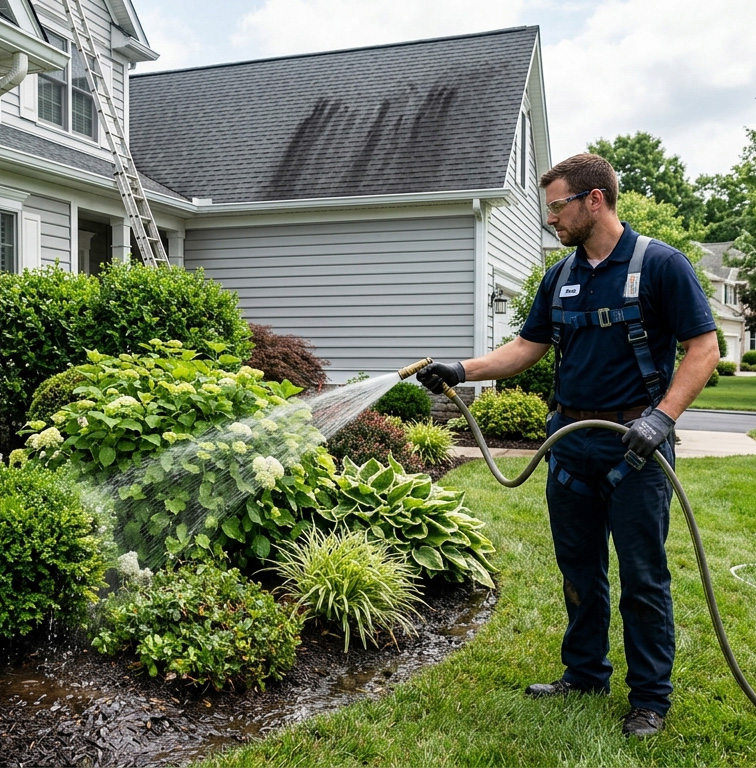
Roof cleaning can harm landscaping if performed carelessly. However, professional soft washing includes proactive plant protection steps:
- pre-watering landscaping – plants are thoroughly soaked with clean water before application. This dilutes any incidental contact;
- controlled application – technicians apply solution precisely, avoiding overspray and runoff concentration;
- biodegradable additives – modern surfactants are designed to break down more quickly than older formulations;
- continuous rinsing – during and after treatment, surrounding areas are rinsed to prevent chemical accumulation;
- post-cleaning inspection – landscaping is checked and re-rinsed if necessary to ensure safety.
When performed correctly, these safeguards significantly reduce environmental risk.
Harsh chemicals vs. responsible application
The real difference is not between “eco” and “chemical.” It is between irresponsible use and controlled, professional use.Harsh chemical cleaning
Harsh chemical cleaning methods typically rely on aggressive application practices. These often include high-concentration chemical mixes and high-pressure washing, which can increase the risk of shingle damage.In many cases, there is no plant protection in place, and runoff is not properly managed. This combination can negatively affect both roofing materials and surrounding landscaping.
Responsible soft washing
Responsible soft washing follows a more controlled and manufacturer-aligned approach. It uses properly calibrated dilution ratios and low-pressure application to protect asphalt shingles. Landscape protection protocols are implemented before and during the process, and thorough post-treatment rinsing is performed.All procedures are designed to remain warranty-safe and compliant with industry guidance.
This second approach provides effective algae removal while maintaining environmental responsibility and protecting your property.
What makes our approach different?
We combine industry-approved soft washing techniques with modern environmental safeguards to ensure both effectiveness and responsibility. Our approach follows asphalt shingle cleaning guidelines aligned with ARMA recommendations, and we never use high-pressure washing on roofing materials.We incorporate biodegradable surfactants that enhance cleaning performance while minimizing environmental impact. At the same time, we implement a strict landscape protection protocol. All plants are pre-soaked before treatment, shielded when necessary, and continuously rinsed throughout the process.
We also integrate F9 and eco-friendly certification standards into our procedures. This includes using certified cleaning solutions and relying on properly trained technicians who follow safety-focused application methods. After treatment, we perform a full system rinse and inspection to ensure the roof and surrounding property are left clean and protected.
This balanced method provides long-lasting results while respecting your home, your landscaping, and the local ecosystem.
How long do results last?
When algae are fully neutralized through soft washing with sodium hypochlorite, the results typically last significantly longer than those from surface-only treatments.Because the organism is eliminated at its source, regrowth cycles slow. This reduces the need for frequent cleanings and minimizes overall environmental impact over time.
Short-term “green-only” treatments may appear safer initially, but repeated applications can increase cumulative chemical exposure and water usage.
Is soft washing safe for asphalt shingles?
Yes, when the process is performed correctly, soft washing is considered safe for asphalt shingles. According to ARMA, the use of low-pressure sodium hypochlorite-based solutions is acceptable for removing algae stains, while high-pressure washing is discouraged because it may damage roofing materials [1].The safety of the method depends on proper execution. This includes using the correct dilution, applying the solution at low pressure, allowing adequate dwell time, and completing a thorough rinse. In most cases, damage occurs due to improper technique rather than the cleaning method itself.
Roof cleaning should restore your home’s appearance without compromising your shingles, landscaping, or the environment. The right method is one that is both effective against Gloeocapsa magma and carefully controlled to protect your property.
If you are looking for a roof cleaning solution that balances performance with environmental responsibility, choose a method built on industry standards, eco-conscious practices, and proven results.
 Facebook
 LinkedIn
 Pinterest
 Twitter