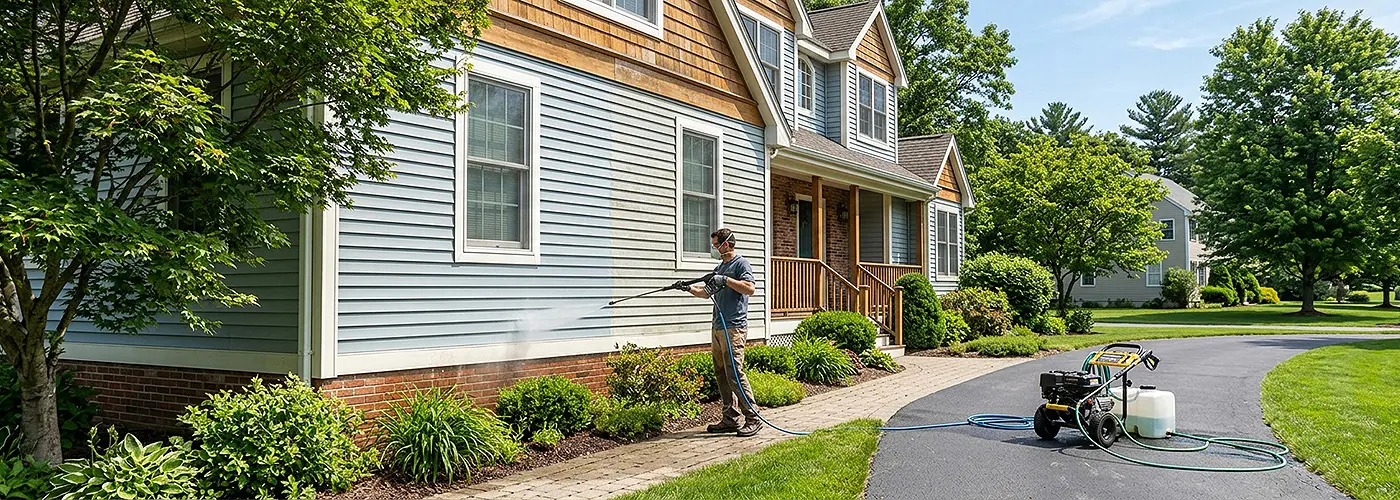
Here's how to figure out where your home actually falls, rather than defaulting to a single number that may not fit your property.
Why there's no single answer
„Once a year“ is only a rough guideline because every home faces different conditions. Siding material, sun exposure, tree cover, nearby water, and humidity all affect how quickly dirt and organic growth build up.A shaded, north-facing wall near a pond may stay damp and need attention sooner, while a sunny wall on the same house can remain clean much longer. That's why washing frequency should reflect the conditions around your home, not a fixed schedule.
The general range, by surface
Every exterior material weathers differently, which is why „once a year“ is a reasonable starting point but not a rule for every surface.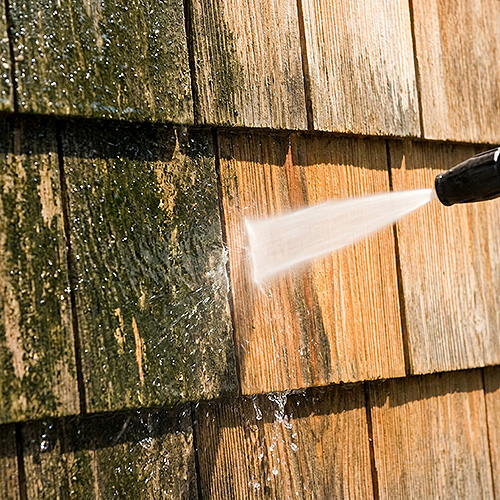
Vinyl siding
Vinyl siding generally does well with an annual wash, although homes with little shade or tree cover may stretch that to every other year. Its low porosity means most buildup stays on the surface.Wood siding
Wood siding typically benefits from cleaning every one to two years. Because wood is porous, it holds dirt, mildew, and algae more easily, so gentle cleaning is especially important.Brick
Brick is durable but porous and can retain moisture. Annual cleaning is common, although less exposed brick may go two to three years between washes.Painted facades and trim
Painted surfaces often benefit from cleaning about once a year because dirt is more visible and can affect the finish. Use gentle methods to avoid damaging otherwise sound paint.Driveways and hard surfaces
Most driveways and other poured surfaces can be cleaned annually. Heavy traffic, oil stains, or winter road salt may make more frequent cleaning useful.Decks
Decks also commonly follow an annual schedule, often coordinated with staining or sealing. Cleaning beforehand prepares the surface for a new finish.None of these ranges guarantees how long a clean will last on your specific property. They're a reasonable starting point that local conditions then adjust up or down.
What pushes these numbers in either direction
A handful of factors specific to Massachusetts consistently shorten or lengthen how often a given surface actually needs attention:- Shade and tree cover
North-facing walls and anything shaded by mature trees stay damp longer and develop algae and mildew faster, often needing attention closer to the shorter end of the range above, or sometimes twice a year. - Proximity to water or the coast
Homes near ponds, rivers, or the ocean deal with sustained humidity and, on the coast, salt residue that accelerates grime buildup beyond what an inland home of the same material would see. - A long, heavy pollen season
Massachusetts springs bring a real volume of tree pollen that settles into siding, windows, and hard surfaces, and a wash timed after peak pollen season often does more good than one scheduled purely by the calendar. - General humidity levels
Humid stretches through summer keep surfaces damp longer between rain events, which gives algae and mildew more opportunity to establish than a drier climate would allow. - Sun exposure
South- and west-facing walls that get consistent direct sun tend to dry out faster and stay cleaner longer than shaded sides of the same house.
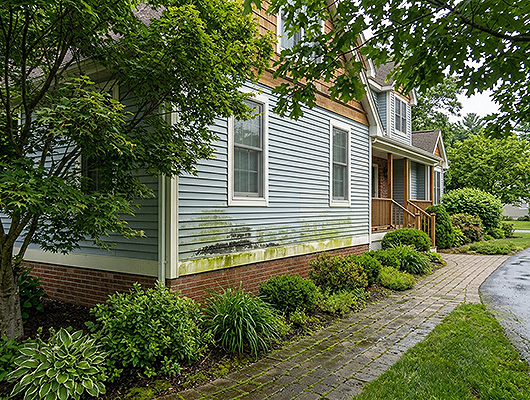
A home with heavy tree cover on a shaded lot near water is a genuinely different case than an open, sun-exposed lot a mile inland, even if both have the same siding material.
Signs you shouldn't wait for the calendar
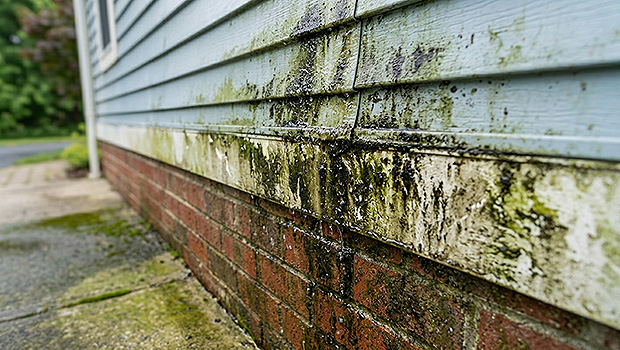
Regardless of what a general schedule suggests, a few visible signs mean it's time regardless of when the last wash happened:- green or black patches developing on siding, brick, or roofing, particularly on shaded or north-facing surfaces;
- a chalky feel when you run your hand across painted siding or trim, which usually means the paint has started breaking down and buildup is accumulating in it;
- surfaces that feel slippery when wet, especially walkways, steps, and decks, which is often algae or mildew rather than just water;
- staining or streaking near gutters and downspouts, where overflow or splash-back tends to show problems first;
- a generally duller, grayer look to siding that doesn't match how the house looked a year or two ago, even without an obvious stain anywhere specific.
Catching these early usually means a more straightforward cleaning. Waiting until growth is heavily established tends to mean it's had more time to work into the material itself, not just sit on top of it.
Soft washing vs. pressure washing: Why the method affects the timeline
The method you use can affect how long results last, which matters when you're thinking about frequency. Soft washing, low pressure combined with a cleaning solution that treats algae and mildew at the source, tends to hold off regrowth longer than pressure washing, which mostly removes what's visible without addressing the organism underneath. That's part of why two homes on the same annual schedule can end up needing attention at different points if one was pressure washed and the other soft washed.As a general rule, hard, non-porous surfaces like concrete and brick tolerate pressure washing well, while painted surfaces, wood, vinyl, and asphalt shingle roofs generally do better with soft washing regardless of how often they're cleaned.
When should you wash your home’s exterior?
Spring and fall are generally the most practical windows for a full exterior wash in Massachusetts. Spring cleaning addresses winter grime and gets ahead of the heaviest pollen buildup, while a fall wash clears summer growth before it has all winter to sit undisturbed.Which season makes more sense for your home often comes down to which side of that seasonal cycle is doing more damage; shaded, algae-prone surfaces benefit most from a spring reset, while sun-exposed, pollen-heavy areas often look and perform best after a late-spring or early-summer wash.
General ranges are a starting point, not a substitute for looking at your specific property. If you're not sure where your home falls, or want a maintenance schedule built around your specific siding, exposure, and surroundings rather than a generic yearly reminder, we're glad to take a look.
Request a free estimate or call 781-333-8758. We'll assess your home's materials and exposure and recommend a realistic maintenance schedule, not just a single wash.
 Facebook
 LinkedIn
 Pinterest
 Twitter