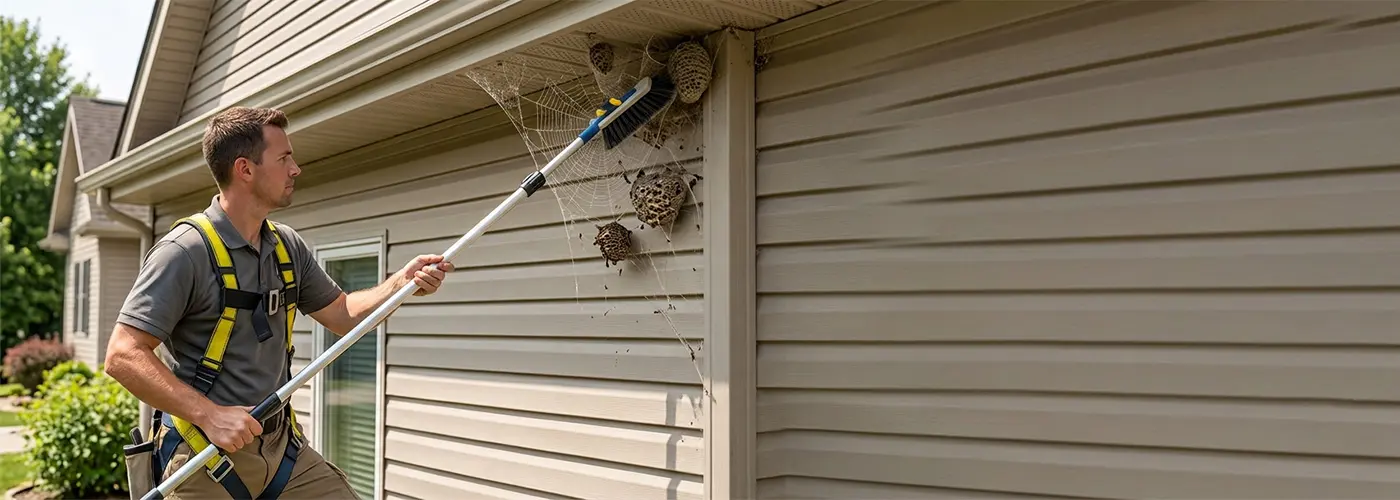
Every year, we see homeowners focus on patios and landscaping while overlooking siding, soffits, eaves, and corners where pests quietly settle. Below, we explain why insects are drawn to dirty façades, how house washing breaks the pest cycle, and why safety is critical when dealing with active nests.
Why do spider webs and insect nests appear so quickly in summer?
Warmer temperatures accelerate insect activity. Wasps, hornets, spiders, and mud daubers become more active in late spring and throughout summer as they search for food, shelter, and nesting sites.Your home’s exterior offers all three.
First, sheltered architectural features such as eaves, soffits, gutters, and corners provide protection from wind and rain. Second, exterior lighting attracts flying insects at night, which in turn attract spiders and predatory wasps. Third, and most overlooked, is surface contamination.
A dirty façade creates a mini ecosystem. Dust, pollen, mold spores, and organic residue collect over time. These particles feed microorganisms and attract small insects. Those small insects become prey for larger insects and spiders. In short, grime feeds the chain.
When this buildup remains untouched, insects interpret it as a stable, food-rich environment. That is when webs multiply, and nests begin to appear under rooflines and along trim boards.
What attracts wasps, hornets, and mud daubers to your home?
Insects do not choose a home at random. They react to environmental signals. When a house exterior has not been washed for a year or longer, it sends exactly the signals they are looking for.Dust and pollen collect on siding and trap moisture. Organic debris and mildew support tiny insect life. Small cracks and textured surfaces make it easier for nests to attach. Quiet corners under eaves and overhangs provide shelter. Exterior lights attract flying insects at night, which then draw spiders and predatory wasps.
Together, these conditions create a welcoming habitat. Mud daubers build narrow mud tubes along walls and under soffits where surfaces remain stable and undisturbed. Wasps and hornets look for protected corners to anchor their paper nests. Spiders settle wherever food is easy to find.
If the exterior stays dirty and untouched, the environment continues to support them.
How house washing disrupts the pest chain
Professional house washing does more than improve appearance. It removes the very conditions insects depend on.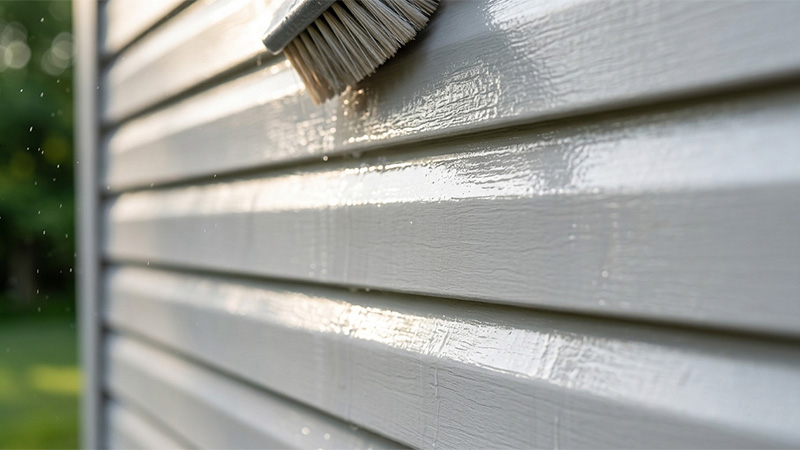
The process works on three levels:
- Physical removal of webs and nests
Existing spider webs, inactive wasp nests, and mud dauber tubes are safely removed from siding, trim, and rooflines. This immediately reduces visible pest activity. - Elimination of organic buildup
Soft washing solutions break down algae, mold, mildew, and organic residue that accumulate on siding. Removing this layer reduces the insect food supply. - Surface reset
Once surfaces are cleaned, they become less textured and less attractive for nest anchoring. Without grime and scent trails, insects are less likely to rebuild in the same spot.
The key is consistency. A seasonal or annual wash interrupts the cycle before colonies establish themselves.
Why you should never remove active wasp or hornet nests yourself
Spider webs can often be carefully removed, but active wasp and hornet nests are a completely different matter. When a nest is disturbed, these insects react defensively. Wasps and hornets can sting more than once and may attack in groups if they feel threatened. Trying to remove a nest without proper protection greatly increases the risk of injury.Active nests require professional treatment. Trained technicians use protective gear and apply treatment before removal to neutralize the threat. They can also safely reach high or difficult areas and check nearby surfaces for additional hidden nests.
Safety should never be compromised. If you notice active wasp or hornet activity, avoid using random sprays or attempting to knock the nest down yourself. Contact a qualified professional to handle the situation properly.
Where pests commonly build on residential exteriors
In our experience, certain areas of a home are particularly vulnerable. These spots combine shelter, elevation, and limited human disturbance.The most common nesting zones include:
- under eaves and soffits – shaded and protected from rain, these areas are ideal for paper wasp nests;
- inside porch ceilings – especially around recessed lighting and corners where warmth accumulates;
- behind shutters and decorative trim – these narrow spaces provide hidden protection from predators;
- along gutter lines and downspouts – mud daubers frequently attach tubes to these surfaces;
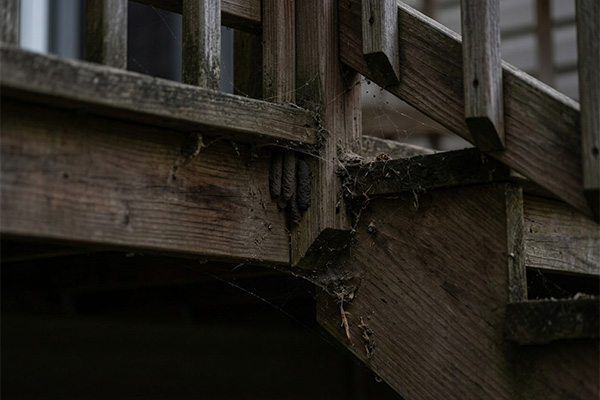
- under deck railings and staircases – low-traffic zones that are rarely cleaned during routine maintenance.
Why a clean exterior matters before summer gatherings
Summer is the time for barbecues, birthdays, and relaxed evenings in the backyard. The last thing you want during a gathering is guests swatting away wasps near the patio lights or entrance.A freshly washed exterior helps prevent that. It reduces visible spider webs around doors and windows and lowers the chances of wasp activity near high-traffic areas. The home also looks cleaner and brighter in photos and under evening lighting, which improves the overall atmosphere.
Beyond appearance, there is peace of mind. You are not constantly checking the roofline for movement or worrying about children playing near hidden nests. Scheduling preventive house washing in late spring is often the smartest approach, because it addresses the problem before peak summer insect activity begins.
How often should you schedule house washing for pest prevention?
For most homes, annual exterior washing provides strong preventive benefits. Properties surrounded by trees, exposed to heavy pollen, or located in humid climates may require more frequent service to stay protected.Timing is important. Scheduling house washing in late spring helps remove winter grime before insect activity peaks and interrupts early nest building. By acting early, you prevent small problems from becoming larger infestations.
Once summer is fully underway, nests are bigger and more established. Preventive scheduling reduces both safety risks and long-term costs.
The long-term benefits of seasonal exterior cleaning
House washing is often viewed purely as cosmetic maintenance. In reality, it supports both structural longevity and pest control.Clean siding and trim:
- reduce organic growth that can degrade materials over time;
- prevent staining from insect activity and mud nests;
- minimize recurring pest settlement patterns;
- maintain curb appeal and property value.
When grime accumulates year after year, the surface becomes increasingly attractive to insects. Regular cleaning breaks that pattern.
If you are preparing for summer events or simply want to reduce pest pressure around your home, seasonal exterior cleaning is one of the most practical preventive steps you can take. A clean home exterior is not just about appearance. It is about safety, comfort, and enjoying your outdoor space without unwelcome guests.
 Facebook
 LinkedIn
 Pinterest
 Twitter