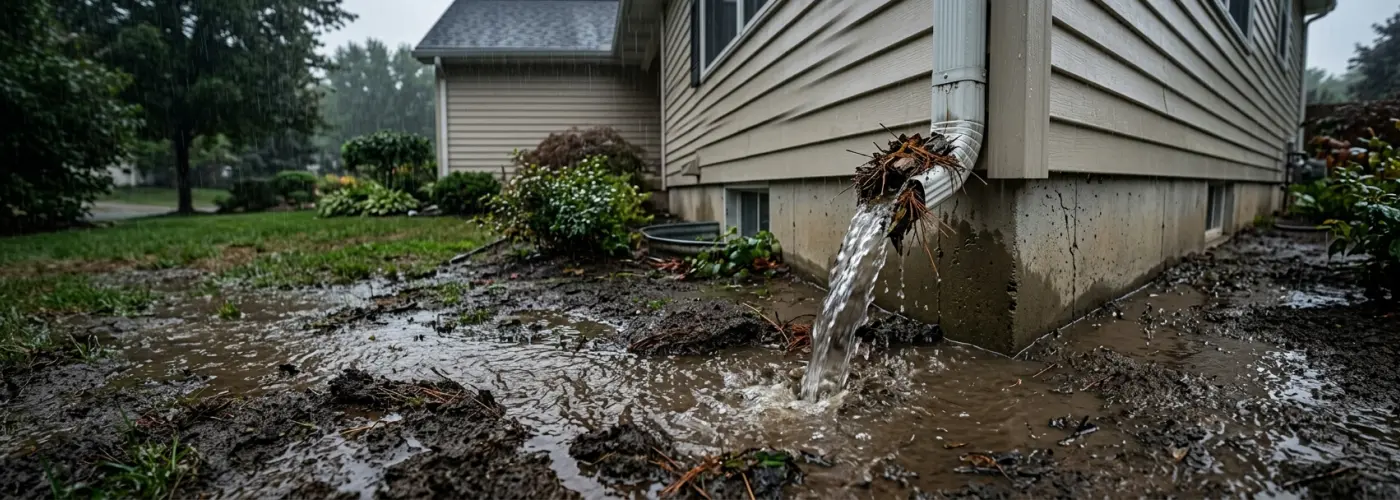
Why clogged downspouts are more than a cosmetic problem
At first glance, a clogged downspout looks like a minor maintenance issue. Leaves, pine needles, and roof debris collect in the gutter system, slowing or completely blocking water flow.However, your gutter and downspout system has one primary function: to move rainwater away from your home’s foundation. When this system fails, the water has nowhere to go except:
- directly against the foundation wall;
- into the surrounding soil near the footing;
- back toward the siding and basement wall;
- into window wells and below-grade openings;
- under slabs and crawl spaces.
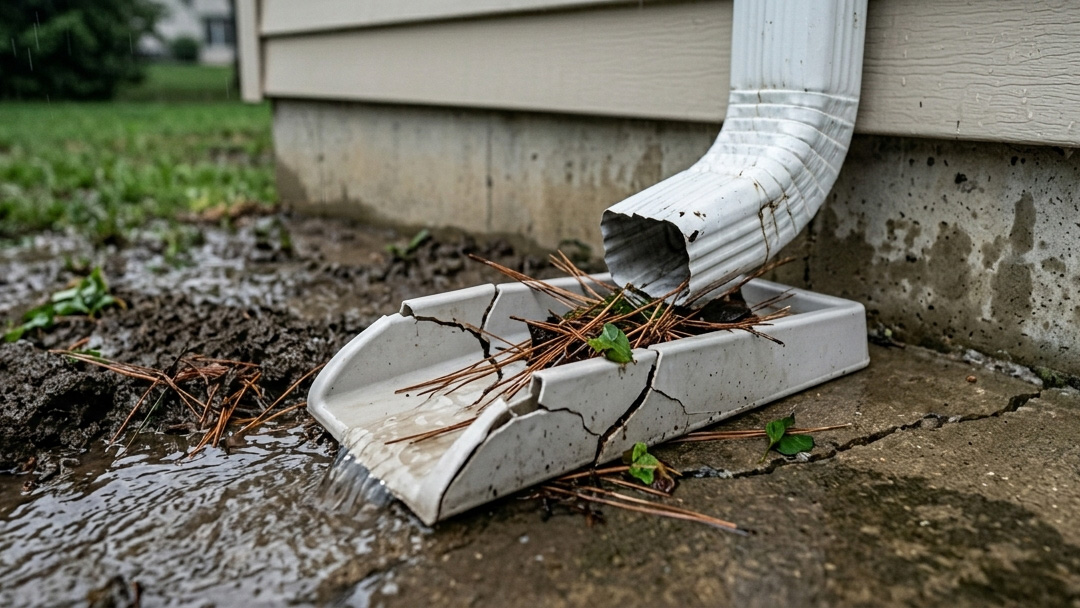
Each of these outcomes increases the risk of long-term structural damage. What starts as a clogged pipe can evolve into soil instability and foundation movement.
How overflowing water damages your foundation
To understand the risk, it helps to look beneath the surface.Soil saturation and erosion
First, excess water saturates the soil around your home. When soil becomes overly wet, it loses load-bearing strength. Over time, this leads to:- Soil erosion
Flowing water washes away fine soil particles. As voids form, sections of the foundation may lose support and begin to settle unevenly. - Expansive soil movement
In many regions, clay-rich soils expand when wet and shrink when dry. This repeated swelling and contraction puts constant pressure on foundation walls. - Differential settlement
When one side of the foundation shifts more than the other, cracks begin to appear in walls, floors, and ceilings.
Uneven settlement is one of the most expensive structural problems a homeowner can face.
Hydrostatic pressure against basement walls
When water collects around a foundation, it increases hydrostatic pressure, which is the force created by standing groundwater pushing against foundation walls. As moisture builds up along the exterior surface, that pressure continues to rise until it finds a point of entry. This can happen through fine hairline cracks in concrete, mortar joints in block foundations, construction joints between separate pours, or small gaps around utility lines.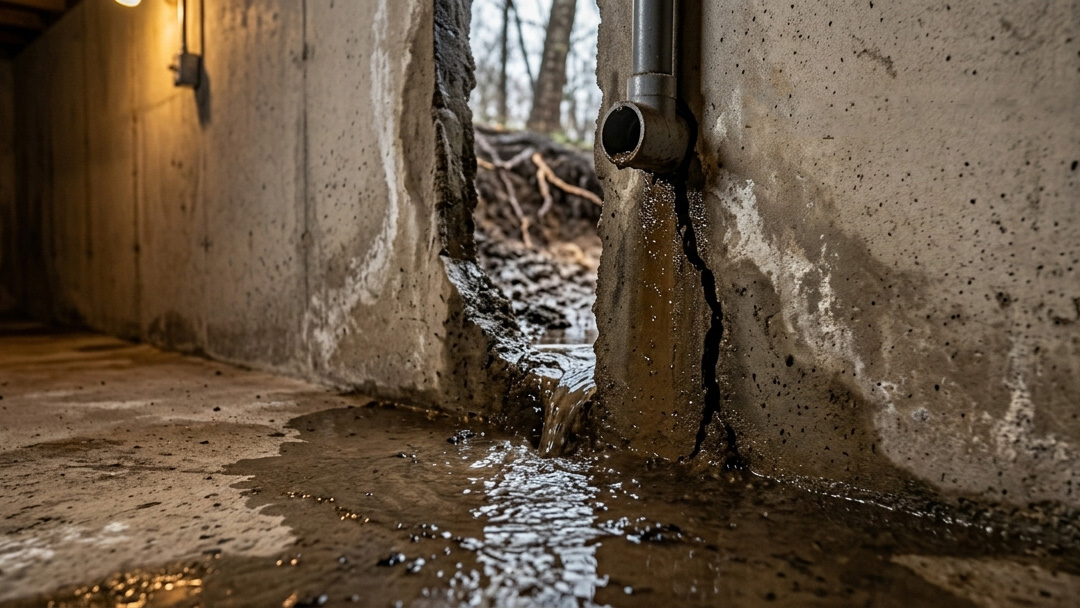
Over time, even minor openings can allow repeated water intrusion, which gradually worsens and leads to more significant structural damage.
What are the warning signs of foundation damage?
Foundation damage rarely appears overnight. Instead, it develops slowly. Watch for these common indicators:- Interior wall cracks
Diagonal cracks above doors and windows often signal uneven foundation movement. - Sticking doors and windows
Frames become misaligned when the structure shifts. - Basement dampness or water intrusion
Persistent moisture, musty odors, or visible water stains suggest drainage failure. - Exterior foundation cracks
Horizontal cracks are especially concerning because they may indicate soil pressure against basement walls. - Pooling water near the home
After heavy rain, standing water within a few feet of your foundation is a red flag.
Early detection dramatically reduces repair costs. Ignoring these signs often results in structural reinforcement, underpinning, or full waterproofing projects.
Why basement flooding becomes a real risk
When downspouts overflow, large volumes of roof runoff collect right next to the foundation. During heavy rain, this concentrated water quickly saturates the surrounding soil. If it is not directed safely away from the house, it begins to pool at the base of the structure, soaking the ground and increasing pressure against the foundation wallsAs the soil becomes fully saturated, hydrostatic pressure builds, forcing water through weak points such as small cracks or gaps. This chain reaction can ultimately lead to basement flooding, causing damaged flooring, mold growth, ruined insulation, and even structural deterioration of framing elements.
How regular maintenance prevents expensive repairs
The good news is that foundation damage caused by clogged downspouts can usually be prevented with simple, consistent maintenance. A proper routine includes cleaning gutters and downspouts seasonally, inspecting the system after major storms, making sure downspout extensions carry water at least 4 to 6 feet away from the foundation, checking that the soil slopes away from the house, and confirming that splash blocks or drain pipes are correctly positioned and undamaged.Compared to the high cost of structural repairs, which can easily reach thousands or even tens of thousands of dollars depending on the extent of the damage, this type of preventive care is both affordable and straightforward.
Best practices for protecting your home’s foundation
Beyond cleaning, additional protective measures can improve long-term drainage performance.Install proper downspout extensions
Downspouts should not discharge directly at the base of the home. Extensions or underground drain lines help move water safely away from the structure.Maintain proper grading
The ground should slope away from the foundation at a minimum grade of about 5 percent for the first 10 feet. This encourages runoff to move away naturally rather than back toward the house.Consider gutter guards
While not a complete solution, gutter guards can reduce debris buildup and lower the frequency of clogs.Inspect the entire drainage system
Water management is a system, not a single component. Check:- gutters;
- downspouts;
- splash blocks;
- underground drains;
- sump pump discharge lines.
All elements must function together to keep water away from the structure.
Why prevention is always cheaper than repair
Foundation repairs often involve structural stabilization, crack injection, wall reinforcement, or interior and exterior waterproofing systems. These solutions are disruptive and costly.In contrast, cleaning your downspouts twice a year and after major storms is a simple task that protects one of the most important structural elements of your home.
Your foundation supports everything above it. Protecting it starts at the roofline, with clear gutters and properly functioning downspouts.
 Facebook
 LinkedIn
 Pinterest
 Twitter